
Chemical Dilution Formula
Solve the dilution equation C₁V₁ = C₂V₂ for whichever value you do not know — stock concentration, stock volume, final concentration or final volume — then plan a serial dilution with the volumes to transfer at every step.
- Free to use
- No sign-up
- Runs in your browser
Solve a dilution
Lab Dilution & Solution Prep Workbook
A solution-preparation workbook with dilution, serial dilution and mass-to-molarity sheets, plus printable reagent labels.
- Dilution & serial dilution workbook (XLSX, PDF)
- Printable reagent labels (PDF, DOCX)
Formats: XLSX, PDF, DOCX. Instant download after payment (link valid 72 hours, up to 5 downloads). AI-assisted: the templates were drafted with AI help and reviewed and laid out before publishing.
$4.00 USD, one-time
- Instant download
- 7-day refund
- Secure checkout by Stripe
7-day money-back guarantee. Full refund within 7 days of purchase, even after you download.
Full refund within 7 days — see the refund policy and license.
Free printables
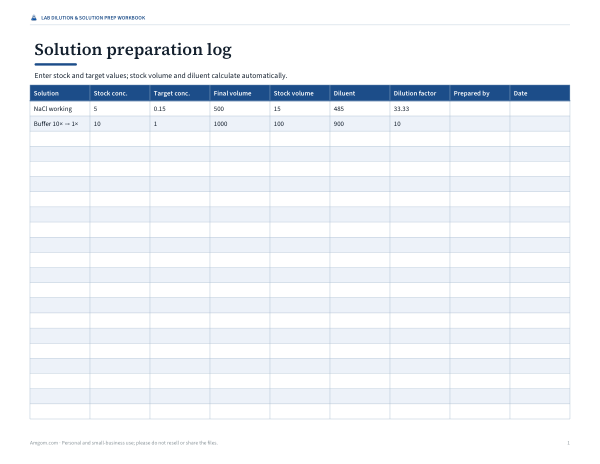
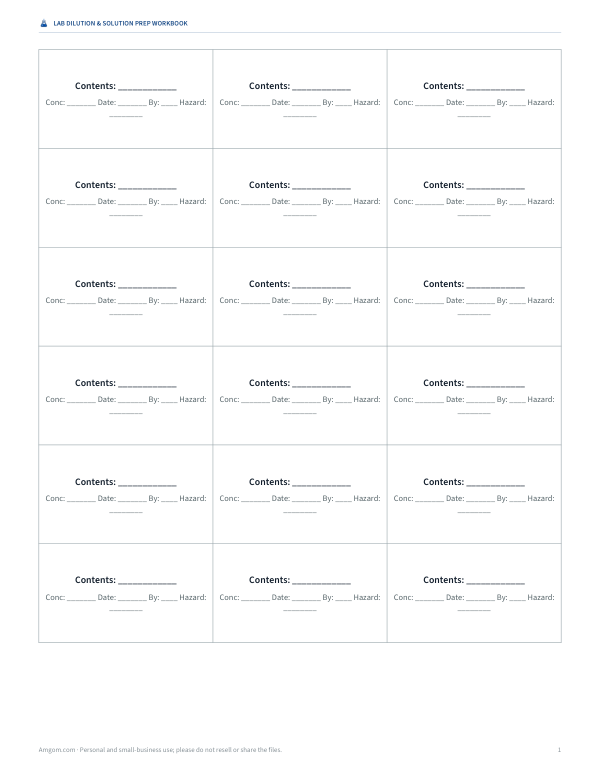
Single sheets you can print right now, no sign-up. The full pack adds every sheet in one download plus the editable files.
The dilution formula
When you dilute a solution, the amount of solute stays the same; only the volume changes. Amount of solute equals concentration times volume, so the amount before and after must be equal: C₁ × V₁ = C₂ × V₂. C₁ and V₁ are the concentration and volume of the stock you start with; C₂ and V₂ are the concentration and total volume you want. Rearranging gives the volume of stock to measure out: V₁ = C₂ × V₂ ÷ C₁.
The formula works with any concentration unit — molarity, millimolar, percent, ppm, mg/mL or “× strength” — as long as C₁ and C₂ are in the same unit, and with any volume unit as long as V₁ and V₂ match.
Worked example
You have a 10 M stock of a reagent and need 100 mL of a 0.5 M working solution. V₁ = 0.5 × 100 ÷ 10 = 5 mL. Measure 5 mL of the stock and add solvent until the total volume is 100 mL — about 95 mL of solvent. The dilution factor is 10 ÷ 0.5 = 20, often written as a 1:20 dilution (1 part stock in 20 parts total).
“Add to” versus “add”
The final volume V₂ is the total volume after mixing, not the volume of solvent added. For accurate work, measure the stock into a volumetric flask and fill to the mark with solvent. Simply adding 95 mL of water to 5 mL of stock gives approximately 100 mL, but some mixtures — such as alcohol and water — change volume slightly on mixing, so filling to volume is more precise. The calculator shows “add diluent to reach” for this reason, plus the approximate amount of diluent.
Dilution ratios and factors
| Written as | Meaning | Stock in 100 mL total |
|---|---|---|
| 1:2 | 1 part stock in 2 parts total (factor 2) | 50 mL |
| 1:5 | Factor 5 | 20 mL |
| 1:10 | Factor 10 | 10 mL |
| 1:20 | Factor 20 | 5 mL |
| 1:100 | Factor 100 | 1 mL |
Be careful: some fields write ratios as parts of stock to parts of diluent (1:9 for a tenfold dilution). Check the convention in your protocol. This page uses the “parts in total” meaning.
Serial dilutions
A serial dilution repeats the same dilution several times, each time using the previous tube as the stock. It is the standard way to reach very low concentrations accurately — for example in microbiology plate counts, standard curves and ELISA assays — because pipetting 0.001 mL is impractical but four tenfold steps of 1 mL into 9 mL are easy. The second calculator lists the transfer volume, the diluent per tube and the concentration of each tube. After n steps with factor f, the concentration is the starting concentration divided by fⁿ.
Percent and ppm solutions
For percent solutions, the same formula applies: to make 500 mL of 2% solution from a 10% stock, V₁ = 2 × 500 ÷ 10 = 100 mL. Parts per million (ppm) behave the same way; in dilute aqueous solutions 1 ppm is about 1 mg per litre. For solid solutes, dilution does not apply directly: to make a solution from powder, calculate the mass needed from the target concentration and volume instead.
Safety when diluting chemicals
- Read the safety data sheet (SDS) and wear appropriate eye protection, gloves and a lab coat.
- Always add acid to water, slowly and with stirring — never water to concentrated acid, which can boil and splatter.
- Dilute in a fume hood when vapours are hazardous.
- Label the new container with contents, concentration, date and your initials.
- Use calibrated pipettes and volumetric glassware for quantitative work.
- Household products: follow the label's dilution directions and never mix bleach with ammonia or acids.
Dilutions in everyday life
The same formula applies outside the lab. Concentrated cleaning products, garden fertilisers and pesticides, photographic chemicals and even squash drinks are all diluted from a stock. A concentrate labelled “1 part to 32 parts water” is a dilution factor of about 33 by the total-parts convention; to make a 1-litre spray bottle you need about 30 mL of concentrate made up to 1 litre. Always follow the product label for dilution rates and safety, because using a stronger solution than directed is not more effective and can be harmful to surfaces, plants or people.
Common dilution mistakes
- Mixing units — millimolar stock with molar target, or microlitres with millilitres.
- Treating V₂ as the solvent volume instead of the final total volume.
- Confusing 1:10 “parts in total” with 1:10 “stock to diluent” (which is actually 1:11).
- Forgetting to mix thoroughly before taking the next serial transfer.
- Diluting a stock that has evaporated or degraded; check expiry dates.
Frequently asked questions
What is the dilution formula?
C₁V₁ = C₂V₂: stock concentration × stock volume = final concentration × final volume.
How do I dilute a 1 M solution to 0.1 M?
Take one part of stock and make up to ten parts total, e.g. 10 mL stock made up to 100 mL.
Does C₁V₁ = C₂V₂ work for percentages?
Yes, as long as both concentrations use the same percent basis.
What is a 1:10 dilution?
One part stock in ten parts total — for example 1 mL stock plus 9 mL diluent.
How do I make a serial dilution?
Transfer a fixed volume from each tube into fresh diluent, mixing each time; the concentration drops by the same factor at every step.
Can I use the formula to concentrate a solution?
Not by adding stock. Concentrating requires removing solvent (evaporation) or adding more solute.
What is the difference between dilution factor and dilution ratio?
The dilution factor is final volume divided by stock volume; a ratio such as 1:10 may mean the same thing or, in some fields, stock to diluent — always check the convention.